


WIRELESS NETWORK SOLUTIONS
Wireless network solutions are an essential part of today’s connected world and we provide a plethora of services like network security and network solutions that help effective and secure global wireless communication. Wireless network solutions are deployed in networks to provide wireless internet access to connected devices. WiFi networks are commonly used for this purpose. Wireless network solutions resolve wireless connectivity issues to enable client devices to connect to each other and external networks. we offer a wide range of high performance outdoor wireless solutions, with class -leading features including:
- Higher wireless throughput
- Longer range
- Greater security
- More rugged
- Easier deployment
- More cost-effective
- More versatile
- Personalized SMB Solutions


WHAT WE OFFER
Wireless Network Design and Installation
Customised wireless network design based on business requirements. Installation of high-performance wireless access points (APs) and routers. Site survey and coverage analysis to ensure optimal wireless coverage
Networking Solutions
Implementation of wireless mesh networks for large and distributed environments. Seamless roaming and continuous coverage across multiple APs. Ideal for large office spaces, campuses, and outdoor environments
Wi-Fi Network Solutions
Secure and scalable Wi-Fi networks for businesses and enterprises Support for dual-band Wi-Fi (2.4GHz and 5GHz) to optimize performance Implementation of guest Wi-Fi solutions with separate network access.
Point-to-Point (PtP) and Point-to-MultiPoint (PtMP) Wireless Links
Setup of secure, high-performance PtP and PtMP wireless connections. Ideal for connecting remote offices, buildings, or campuses. Wireless backhaul solutions to extend network coverage
Wireless LAN (WLAN) Setup
Design, configuration, and installation of enterprise-level WLAN systems Integration of WLAN with existing network infrastructure. High-speed and reliable wireless access across offices and campuses.
Wireless Site Surveys and Planning
On-site surveys to assess signal strength, interference, and coverage gaps. Planning of AP placement for optimal wireless performance. Real-time analysis and adjustments to eliminate dead spots and improve connectivity

ADVANTAGES OF WIRELESS NETWORK
Mobility and collaboration
Accessibility
Expandability
Guest access
CHOOSING PROFESSIONALS
- Identify your specific requirements: Determine the size of your network, coverage area, and the types of devices you need to connect.
- Consider your budget: Set a realistic budget for your wireless solution.
- Look for best providers: Research companies with a strong track record in wireless solutions.
- Provide detailed information:Clearly outline your specific needs, budget, and timeline.
- Compare proposals:Evaluate proposals from different providers based on pricing, services offered, and contract terms.
- Check customer references: Ask for references from previous clients to get their feedback.
- Evaluate responsiveness: Assess how quickly providers respond to inquiries and requests.
- Ask questions: Don’t hesitate to ask questions and seek clarification.

STRUCTURED CABLING SOLUTIONS
A structured cabling system allows organizations to eliminate the complexity of multiple wiring and enable the advantage of a structured cabling environment. This enhances the aesthetic of the building and creates a high-performing infrastructure for the current needs.
Today’s industry is based upon highly technical systems and processes, which ideally require reliable cabling solutions to serve as a medium that facilitates the complex operations of an organisation. We expertise to deliver such cabling solutions that provide an efficient cable infrastructure to carry out the process of cabling with utmost precision and in an orderly manner. It helps us to thoroughly understand the requirements of the business and then deliver it within the stipulated time frame.
We understands that every business requires different structured network cabling according to their needs & domain and offers the best-quality structured cabling services. We use industry-standardized layouts for office backbone connections, which are implemented using top-quality fiber optic, CAT6 cables. This ensures that your network is equipped with the latest technology and that your infrastructure is future-proof.


WHAT IS STRUCTURED CABLING?
Structured cabling is the standardised architecture layout of cables to enable interoperability, and this telecommunications infrastructure consists of various smaller elements to ensure performance scope to accommodate changes and maximise system availability. Key Components of a Structured Cabling System.
Horizontal Cabling
Vertical Cabling (Backbone Cabling):
Patch Panels and Cross Connects:
Work Area Components:
PASSIVE ITEM BRANDS


WHY YOU CHOOSE US
One platform. Build quickly.
What is Rack Dressing?
Rack dressing in a server room refers to the organisation and management of cables and equipment within a server rack. This process involves neatly arranging and securing all cables and components to ensure a tidy and efficient setup. Proper rack dressing is crucial for several reasons:
What is Cabling Refresh?
A cabling refresh refers to the process of upgrading or replacing the existing network cabling infrastructure within an organisation. Over time, network cabling may become outdated, unreliable, or unable to support the increasing demands of modern technology. A cablish refresh or rack tidy increases efficiency.
What is Cable Management?
Improving cable management from a rack level will benefit your server rack and equipment performance and impact your overall data centre performance. Effective server rack cable management improves efficiency, performance, serviceability and scalability.
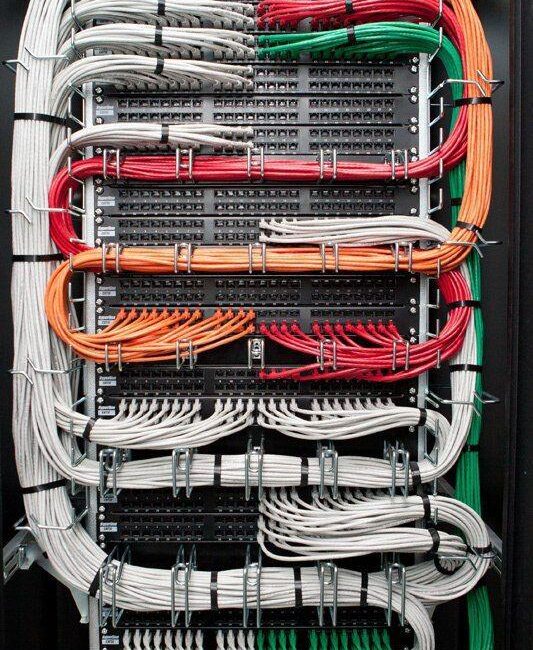
ADVANTAGE OF RACK DRESSING?
Facilitates Maintenance:
A well-organized rack makes it easier to access components for maintenance, troubleshoting, and upgrades.
Professional Appearance:
A tidy server room reflects positively on the organization’s attention to detail and professionalism.
Improves Efficiency:
Efficient cable and equipment organisation can lead to reduced downtime and faster resolution of issues.
Optimizes Airflow:
Neatly organised cables ensure better airflow within racks, reducing the risk of overheating.
Enhances Safety:
Proper cable management minimizes tripping hazards and electrical risks, promoting a safer work environment.
Future Expansion:
Planning for future growth during rack dressing avoids the need for complete reorgnisation later, saving time and resources.